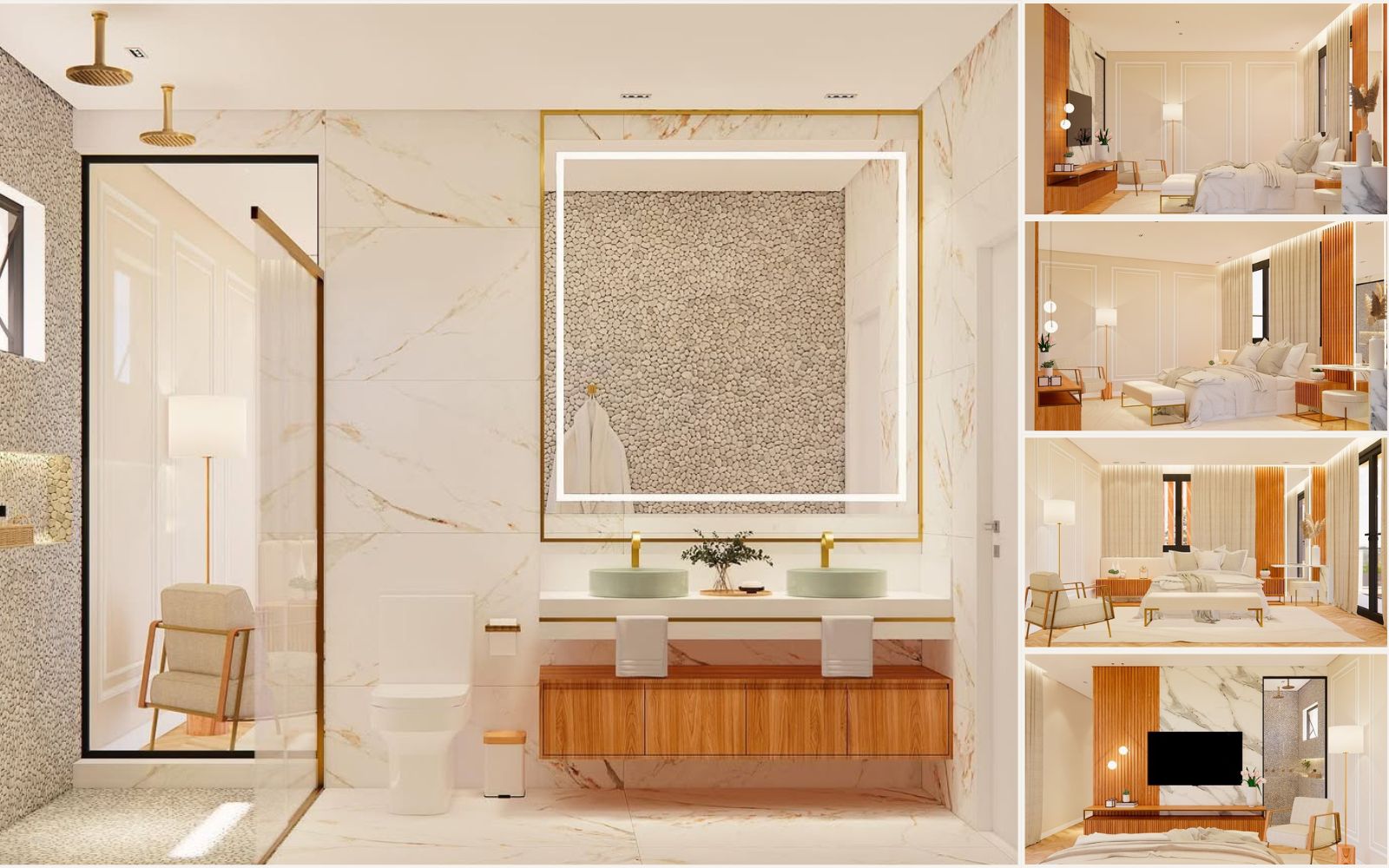
Where the bedroom ends and the bath begins
A primary suite designed as one continuous environment — a study in the threshold that almost disappears.
The line between the bedroom and the bathroom is the most consequential decision in a primary suite, and most of the time it is made by accident.
The instinct in residential design is to treat the two as separate environments. Two doors. Two atmospheres. Two sets of decisions. The instinct in hospitality design is the opposite: a luxury hotel suite reads as one continuous space, with the bath visible from the bed and the bed implied from the bath. The threshold dissolves.
This project took the hospitality side of the argument. The decision shaped everything downstream — the marble palette, the lighting plan, the placement of the shower enclosure, the way the wood paneling carries across the doorway. It is a small line on a plan and a large one in the life of the room.
What follows is the thinking that went into it.
The brief, in one paragraph
The clients wanted a primary suite with the intimacy of a luxury hotel — but warmer. Not the staged, anonymous warmth of a five-star room serviced for a stranger. The warmth a hotel almost never achieves: the warmth of a place that belongs to someone.
That is the hardest brief in residential. A hotel can rehearse intimacy. A home has to actually carry it.
Four materials, in conversation
The project resolves around four materials, each chosen against a specific failure mode.
Polished Calacatta Gold marble on the bathroom walls and on the floor of the bedroom. Calacatta carries the gold veining that warms what would otherwise be a cool palette. This matters more than it sounds — pure white marble in a primary bedroom reads clinical within weeks of moving in.
Natural stone pebble as the feature wall behind the vanity, continuing into the shower zone. This is the move that made the project work. The raw, irregular texture of river stone is the deliberate counterweight to the polished marble. Without it, the room would slide into hotel-lobby formality. With it, the suite holds tension between refined and grounded, polished and hand-touched.
Brushed brass on every fixture — Brizo for the plumbing, custom profiles on the cabinet pulls. Brass warms light differently than chrome or matte black. In a room where the lighting palette runs warm (3000K throughout), that matters more than it photographs.
Teak floating vanity and bedroom wall paneling. Teak is the material that carries the room’s warmth across the threshold. The headboard wall, the floating vanity, and the TV panel surround all read as the same wood family. That continuity is what sells the one-room argument.
Three lighting layers, no decorative noise
Bedrooms and bathrooms are the rooms where bad lighting is most punishing. Too bright at the wrong moment, too dim at the wrong moment, and the day starts or ends wrong. The suite was lit in three layers, each doing exactly one job.
Ambient — concealed cove with indirect LED strip. The cove runs the perimeter of the ceiling in the bedroom and continues into the bath. It is the layer no one consciously notices. Its job is to fill the room with soft diffuse light from above without ever being a source you look at. This is the layer that makes the room read as lit at low intensity — which is what a primary suite needs most evenings.
Task — recessed downlights and front-facing vanity LED. Downlights at the dressing zone and bedside, all 3000K, CRI 90+, on dimmers. At the vanity, an integrated linear LED strip on the mirror frame, front-facing — not the standard above-the-mirror placement that throws shadow under the eyes. Front-facing vanity light is the difference between getting ready in a hotel and getting ready in your home.
Accent — pebble wall LED strip and bedside sconces. A dimmable LED strip recessed into the natural pebble feature wall, grazing the texture from above. The light catches every irregularity in the stone and turns the wall into a sculpted plane after dark. Bedside sconces (Visual Comfort Scala Large) for reading light at the correct angle and height.
Three layers. No fixture in the room is doing two jobs. That is the discipline.
What the drawings carry
A primary suite at this level does not survive being thought through once and then handed off. It survives because every decision is documented in a way the contractor can build from.
The drawing set for this project includes the furniture layout plan with FF&E legend, the floor finish plan with material codes, the lighting reflected ceiling plan with fixture schedule, and the plumbing plan with every fixture identified by Kohler and Brizo product codes. The specification book includes brand-level callouts, mounting heights AFF, and notes that survive every field condition the site will eventually throw at the design.
This is the part of the work that does not photograph well, and it is the part that decides whether the room actually gets built the way it was drawn.
The argument
The reason a project like this earns the word luxury is not the marble. It is not the brass. It is the fact that every decision — from the choice to read bedroom and bath as one room, to the height of the cove, to the brand of the shower body — was made by one person holding all of them at once.
Luxury, when it is real, is what coherence looks like at scale.
The full drawing set, mood boards, and additional views of this project live in my interior design portfolio. If you would like to talk about a primary suite of your own — or about how to approach the bedroom-to-bath transition in a renovation — write to me directly.