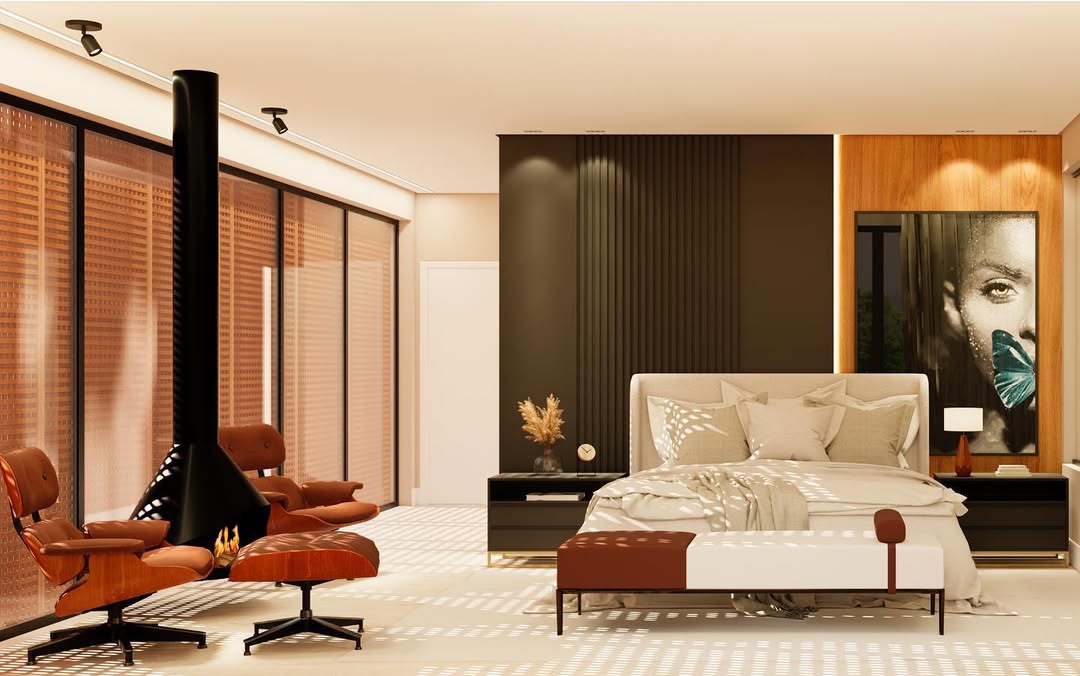
The room that chose the floor
A weekend bedroom organized around the water, and the case for putting the heaviest stone underfoot.
The brief for this one arrived as a sentence, not a program. A young couple wanted their weekend house to feel like an actual escape — a place to slow down, open a good bottle of wine, and lose track of which day it was. Everything I drew after that traced back to a single fact about the site: the suite looked out over a lake, and the lake was the reason to be there at all.
So the room didn’t start with a material. It started with a view, and a decision about how to surrender to it.
The house sits inside a gated lakeside condominium, and the bedroom was positioned at the edge that faced the water. That much the land decided for me. What I decided was to take it all the way — floor-to-ceiling glass on that face, the bed turned to look straight at the lagoon, the whole suite organized as a single gesture toward the outside. The window came from two places at once: the site asked for it, and I chose to let it run the room. Once the glass was that big, every other surface in the space had a new job. It had to hold its own quietly, because the loudest thing in the room was already going to be the water.
That is the condition that sent the travertine to the floor.
I’ve written before about how travertine came back wrong — brought back as a nine-millimeter veneer climbing the walls, a heavy stone asked to behave like wallpaper. The argument I made there has a quieter corollary I didn’t get to, and this room is where I’d make it: if travertine is mass, the most honest place to use it is the one plane you stand on. The floor is the only surface in a room that is unambiguously about weight. You don’t look at a floor the way you look at a feature wall; you trust it. You put your weight on it without thinking. A stone with a few thousand years of geological time behind it belongs there more than it belongs anywhere a swatch could go.
So the travertine here is vein-cut, in solid slab — not sheet. Vein-cut because it’s the calm choice, the one that sits linear and legible under everything else and doesn’t fight the wood or the light. I’ve said vein-cut is the safe yes, and I meant it as a compliment: in a room already carrying a lagoon, a fireplace, and a wall of dark fluted walnut, the floor’s job was to be the steady ground all of that stood on. This was not the room to make the stone the event. It was the room to make the stone the thing everything else could be heavier or quieter against.
And then I left the rest of the room alone.
This is the part I care about most, and it’s the part that doesn’t photograph as a decision because it photographs as an absence. The travertine stops at the floor. It does not climb the headboard wall — that’s smoked walnut, fluted, a different mass doing a different job. It does not wrap into the bathroom as a matching surface. One heavy material, one plane, one clear assignment. The sophistication in a heavy stone was never in how much of it you could afford to show. It’s in the confidence to put it in one place and trust it to hold.
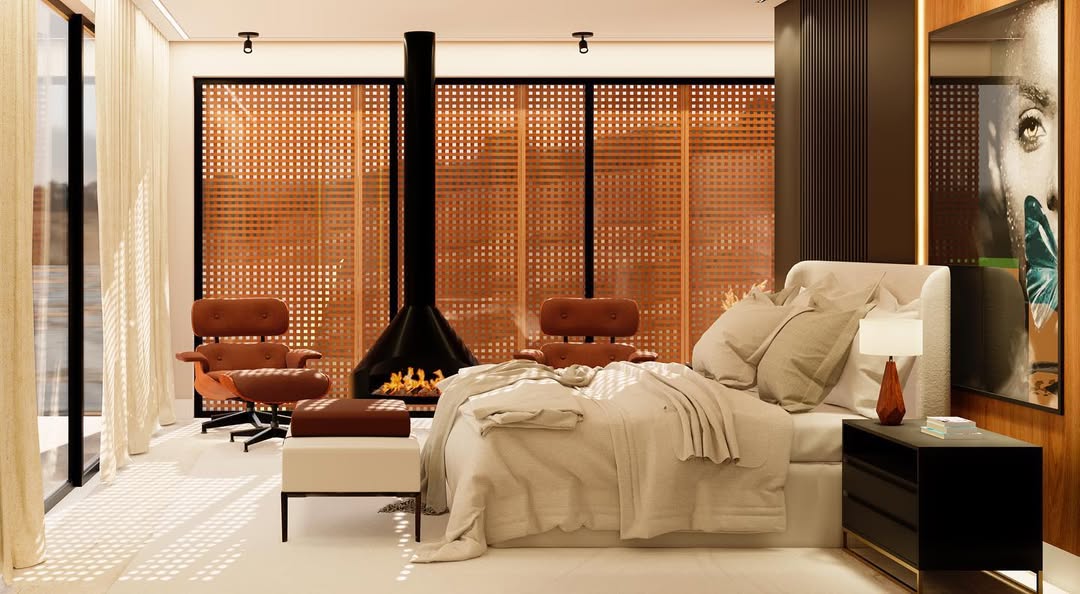
The headboard wall in fluted smoked walnut, the suspended fireplace as focal mass — a separate material from the floor, deliberately. [IMAGEM: detalhe da parede da cabeceira + lareira suspensa]
The bathroom is where the room makes its one sharp move. Instead of carrying the travertine through — the obvious, comfortable choice — the wet wall behind the shower is black river pebble. It’s the only genuinely dark, genuinely textured surface in the suite, and it’s there on purpose. A black-and-pale contrast, placed once, reads as intention; the same contrast spread everywhere reads as fatigue. The pebble wall keeps the palette from going soft and monotone, and it quietly rhymes with the other deliberate dark notes in the project — the way a single piece of art over a pale wall can organize everything around it. One dark gesture, doing the work of ten.
That logic — pick the contrast, place it once, let it earn its keep — is the same logic as the floor. Both are answers to the same question, which is the only question that actually matters with heavy material: not what do I cover, but where does this one thing belong.
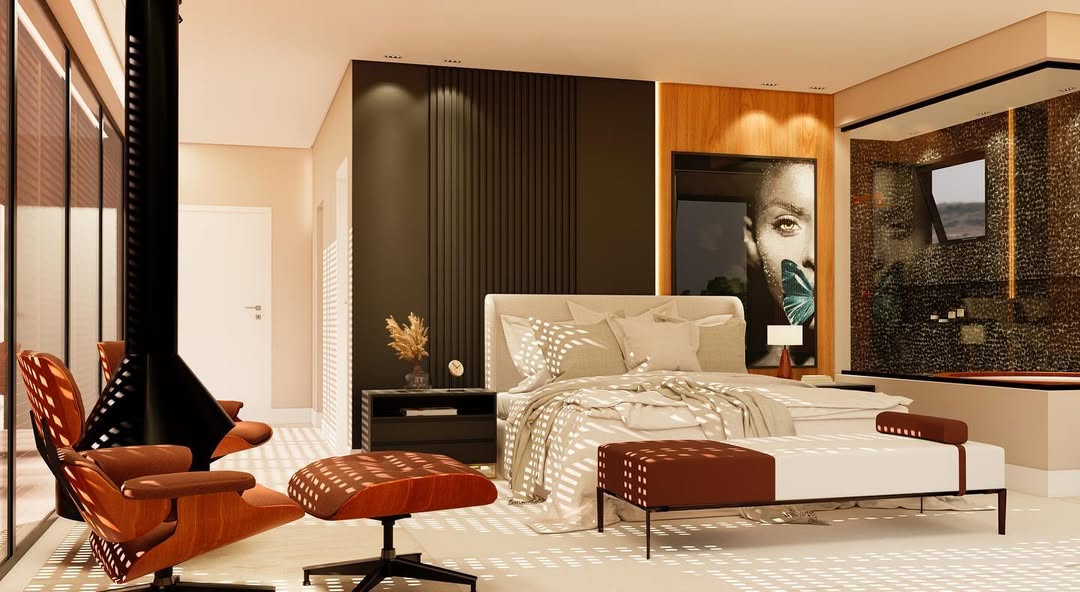
The en-suite — black river pebble as the single dark gesture, contrast placed once rather than spread. [IMAGEM: banheiro, parede de seixo preto no box]
A word on the light, because people assume a moody room is an exercise in fixtures, and this one wasn’t. The partido here was natural light first. The terrace is screened with a muxarabi — a perforated wood brise, an old device with deep roots in Brazilian and Moorish building — and in the afternoon it does something a fixture can’t buy: it breaks the sun into a grid of soft shadow that travels across the floor and the bed as the day turns. That gridded shadow is the room’s primary lighting texture, and it’s the most luxurious thing in the space precisely because nobody specified it from a catalog. It’s comfortable, it’s enveloping, and it’s free. The artificial layer — the suspended fireplace’s glow, a single table lamp, the concealed warm sources — was planned only to extend that mood after dark, never to compete with it. When the natural light is doing work that good, the discipline is knowing how little to add.
The muxarabi screen breaking afternoon sun into a moving grid of shadow across the travertine floor — the room’s primary lighting texture, unspecifiable and free.
What I keep taking from this project is how much of it was subtraction. The window came from the land and from a decision to commit to it. The travertine went to the floor because the floor is where weight is honest. The contrast went to one wall because one is where it stays sophisticated. Almost every move was a decision about restraint — one dominant material per zone, never two competing, never the same surface trying to prove itself twice.
A weekend house is supposed to be the place you stop performing. It would be a strange thing to design one that spends all day performing for you. This room doesn’t. It picks its few heavy things, sets each one down exactly once, and then gets quiet enough to let the water be the loudest thing in it.
If you’re working through where a heavy material belongs in a residential project — and where it’s quietly working against the room — that’s a conversation I’m always glad to have. Write to me at [email protected].