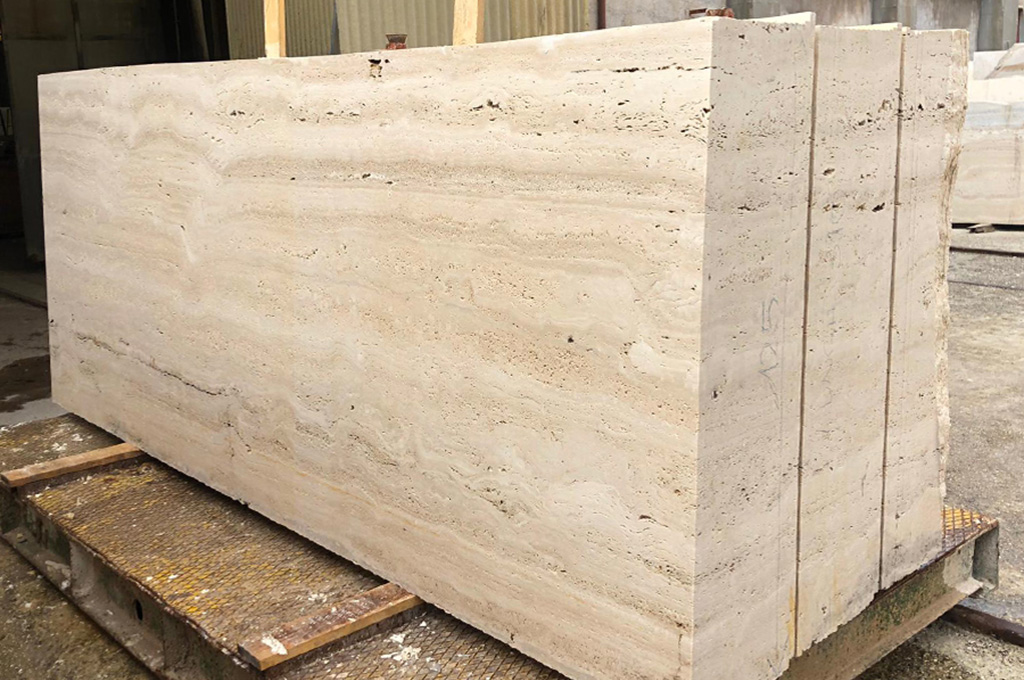
The stone that forgot how much it weighs
Travertine came back as a trend, and the trend got it backwards.
Walk up to a travertine wall in almost any new luxury build and the stone will tell on itself at the corner. The face looks like solid rock. The edge is nine millimeters of veneer glued to substrate, and the seam where two sheets meet doesn’t quite line up, because veining cut for a photograph was never cut to turn a corner. The stone is pretending to be something it isn’t, and the building paid a great deal of money to make it lie.
That is the strange thing about travertine’s return. It came back everywhere at once, and almost nobody brought back the one quality that made it worth wanting.
Travertine is a heavy material. Not heavy as in expensive, heavy as in old — it’s a sedimentary stone laid down over thousands of years by mineral springs, pore by pore, the gaps in it a record of the gas that escaped while it formed. It was never a surface. It was mass. The Romans clad the Colosseum in it because it could hold a building up, not because it looked good in a swatch. When you treat a material with that kind of geological time behind it as a peel-and-stick finish, you don’t elevate the room. You flatten the stone.
You can see the misunderstanding most clearly when the stone is everywhere. Floor in travertine, walls in travertine, the bar in travertine, the counter in travertine, a bench in travertine — the whole room wrapped in one material until it reads less like a design decision and more like an argument the room is having with itself about how much it cost. Saturation doesn’t communicate sophistication. It communicates effort. And sophistication is the absence of visible effort. The room that has to cover every surface is trying to prove something; the room that places the stone once, exactly, has nothing to prove. That restraint is the whole tell.

So where does travertine actually earn its place?
In the gesture, not the coating. A long dining room with a recessed bar niche — the stone set deep into the wall, introverted, a block that pulls back instead of pushing forward. A single wall of travertine with one piece of art floating over it, the stone reading as ground rather than ornament. A bathroom vanity carved as one continuous mass, floor to basin, the sink shaped out of the stone instead of dropped into a slab of it. In each of these the travertine is doing structural work for the eye. It anchors. It has somewhere to be. It is the heaviest thing in the room and it behaves like it.
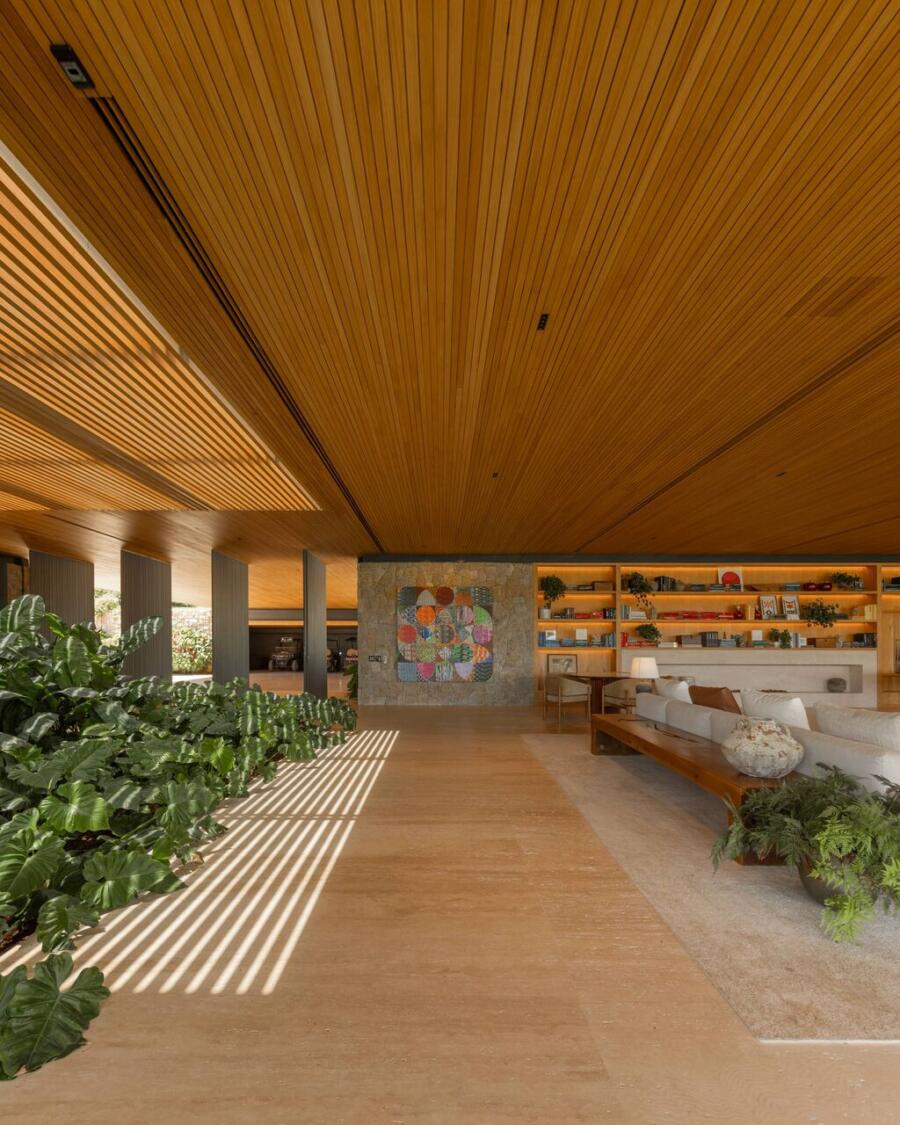
There’s a quieter decision underneath all of this, and it’s the cut. Vein-cut travertine — sliced along the bedding plane so the lines run linear and horizontal — is the one the American market has largely settled on, and for good reason: it’s calm, it’s legible, it sits well behind almost anything. Cross-cut, sliced against the grain so the stone opens into soft cloud-like rounds, is the harder choice. It carries more movement, asks more of the room around it, and punishes a careless placement. Neither is better. But the vein-cut is the safe yes, and the cross-cut is the bet that only pays off when someone knew exactly why they were making it. Most of the travertine going up right now is vein-cut for precisely that reason — it’s the choice that forgives. The interesting work is usually the one that didn’t need forgiving.
Here’s the thing I keep coming back to. Travertine doesn’t ask to be looked at. It asks to be felt as weight — to sit in a room the way a boulder sits in a field, like it was there before you walked in and will be there after you leave. A nine-millimeter sheet can’t do that. It can only describe the feeling from the outside.
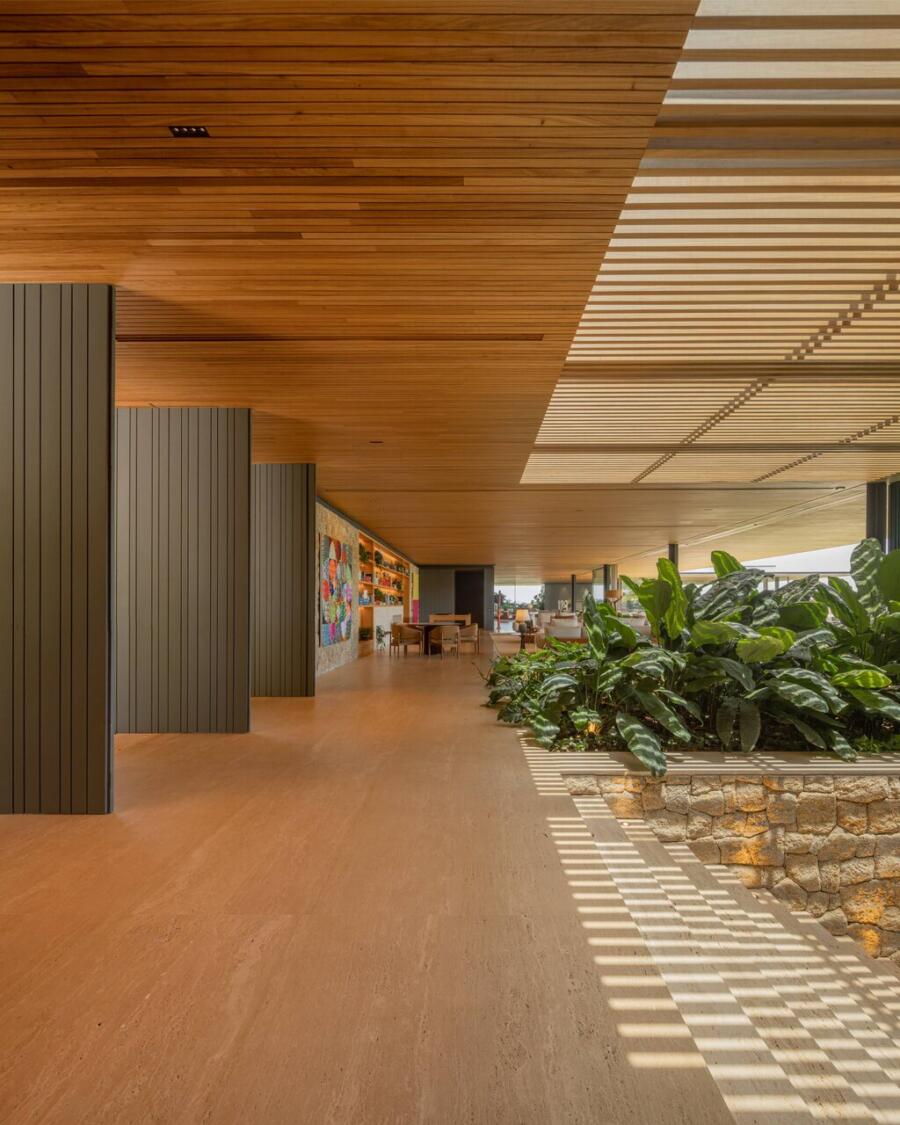

The most sophisticated thing you can do with this stone is also the cheapest: decide where not to put it. Pick the one wall. Carve the one mass. Let the rest of the room be quiet enough that the travertine has something to be heavier than. The luxury was never in the quantity of stone. It was always in the confidence to use less of it.
If you’re working through where a heavy material belongs in a project — and where it’s quietly working against you — that’s a conversation I’m always glad to have. Write to me at [email protected].