The Brazilian Masters
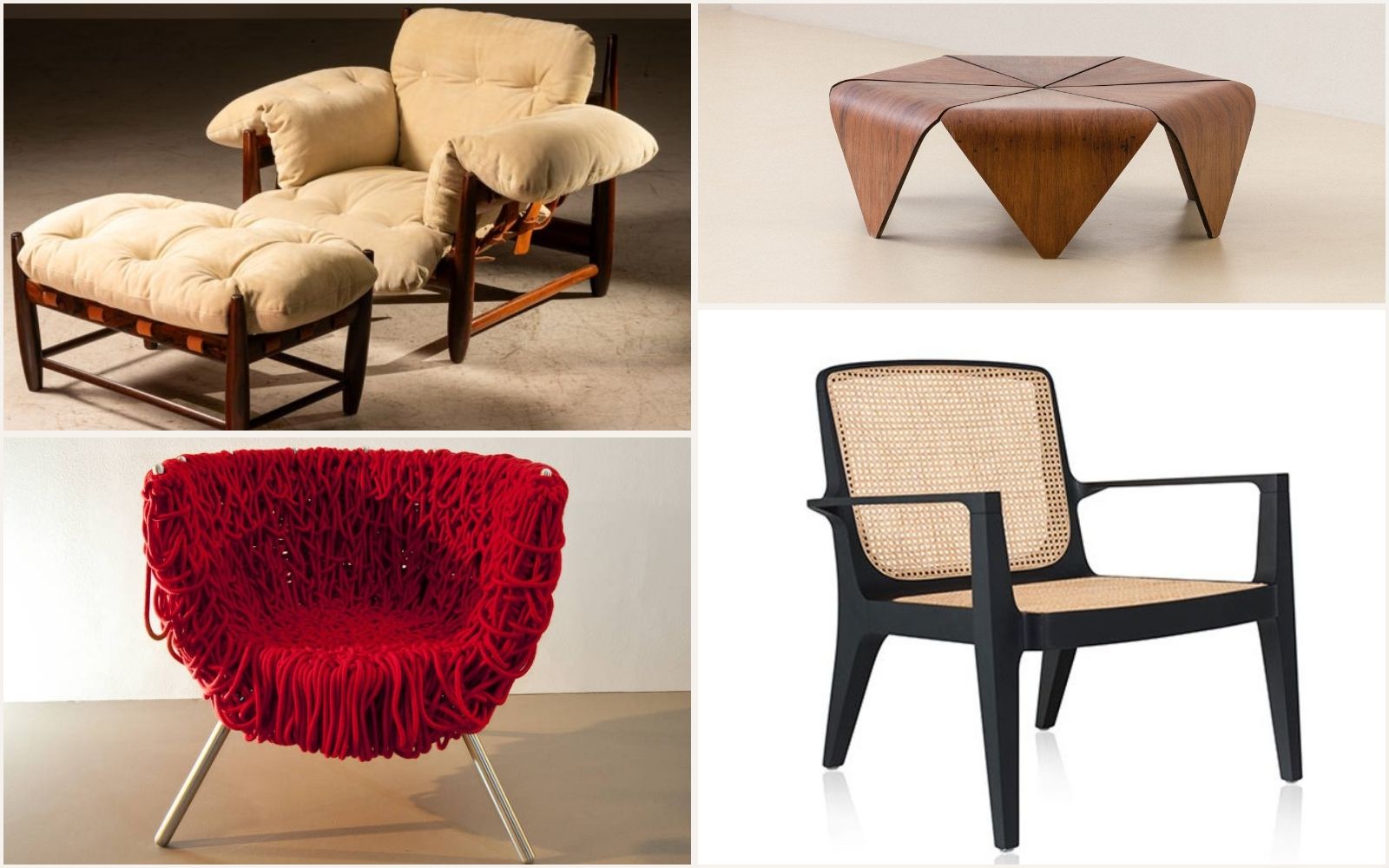
Five Brazilian furniture designers who belong in the same sentence as any European house of authored design.
When a studio in New York wants to signal serious intent in a living room, it reaches for a name from Milan or Copenhagen. A Cassina. A Carl Hansen. The reflex is so automatic that most designers never notice it is a reflex — that authored furniture has been quietly defined as European, and everything else is regional flavor.
I want to argue against that reflex, and I want to do it with objects rather than adjectives. Because Brazil produced — and is still producing — furniture that sits at exactly that altitude. Not folkloric, not charming, not interesting for where it comes from. High design in the only sense that survives scrutiny: a specific hand, a defensible concept, and a piece that could not have been made by anyone else.
Five designers. Five hands. One argument — that the top tier of authored furniture has a Brazilian wing, and these are the names on the door.
Sergio Rodrigues — the weight of warmth
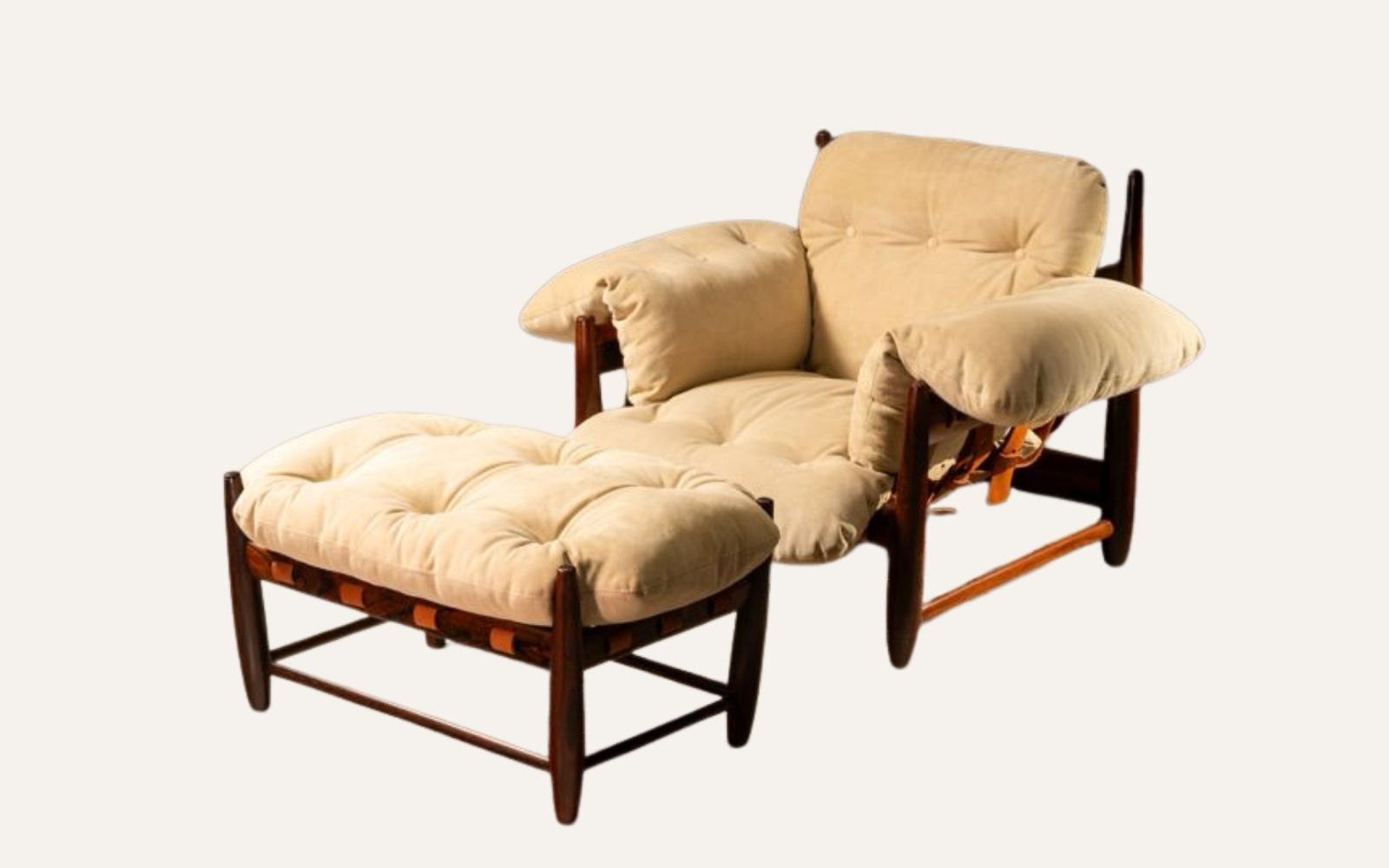 Mole armchair (1957), Sergio Rodrigues. Credit + license to be confirmed before publishing.
Start with the hand that defined what a serious Brazilian object even feels like.
Sergio Rodrigues worked in heavy native wood — jacarandá above all — and his signature was the refusal to hide it. Thick frames, exposed joinery, the structure of the piece presented as the beauty of the piece. Where European modernism of his era prized lightness and concealment, Rodrigues prized mass and honesty. You are meant to see how his furniture is held together. The joint is not a problem to solve; it is the ornament.
His defining piece is the Mole armchair of 1957 — mole meaning soft, slack, the opposite of formal. A robust jacarandá frame, exposed pegged joints, and leather thrown over it in deep, generous folds rather than stretched tight. It reads as relaxed, almost careless, and that ease is entirely engineered. Rodrigues built a chair that was intellectually rigorous and physically inviting at once, and in doing so he established the central trait of Brazilian high design: warmth carried by weight. The value is not in restraint. It is in the density of the material and the confidence to leave it bare.
To specify a Mole today is to anchor a room in that confidence. It is the piece I reach for when an interior is becoming too cautious and needs something with body.
Jorge Zalszupin — precision with a pulse
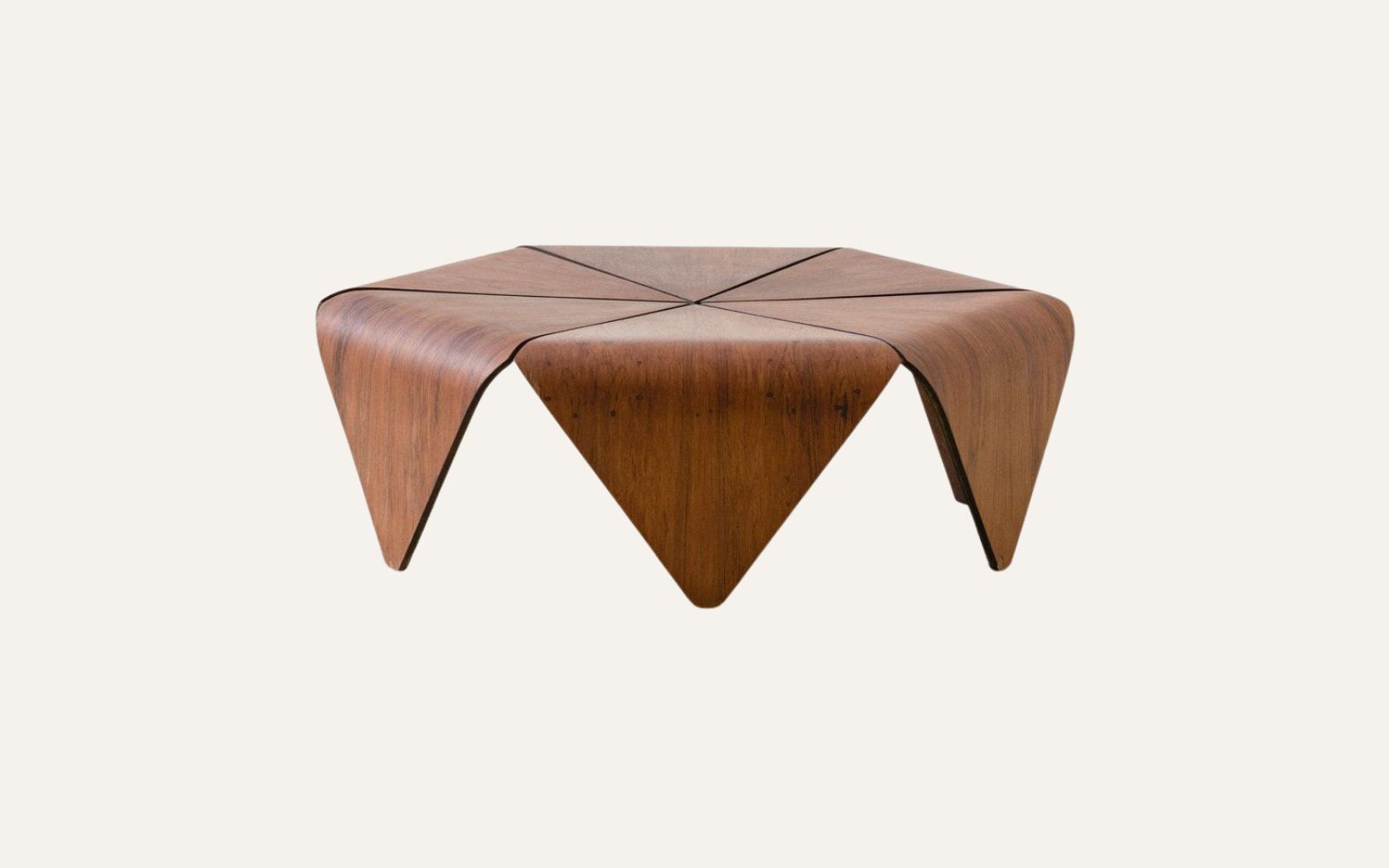 Pétalas table (1959), Jorge Zalszupin. Credit + license to be confirmed before publishing.
If Rodrigues is warmth, Zalszupin is intelligence — the most exacting hand among the Brazilian masters.
A Polish architect who arrived in São Paulo after the war, Zalszupin brought a European structural rigor and ran it through Brazilian wood and Brazilian light. His traço is geometric, controlled, almost severe — and then it warms, because the material will not let it stay cold. His furniture has the discipline of an architect’s mind and the surface of a craftsman’s love. That tension is the whole signature.
His Pétalas table of 1959 is the clearest statement of it. The top is assembled from individually cut segments of jacarandá, fanned like overlapping petals, each piece placed so the grain turns and catches light differently across the surface. It is rigorous geometry and sensual material in the same object — a table that a mathematician and a woodworker would both recognize as theirs. Zalszupin also understood, earlier than most, that an authored piece must be reproducible without losing its soul, and he built his work to survive that translation. The result is furniture that feels inevitable: nothing arbitrary, nothing decorative, everything resolved.
In a project, a Zalszupin piece does quiet, exacting work. It is for the client who reads a room slowly and rewards the detail that took the longest to get right.
Carlos Motta — the hand that remembers the tree
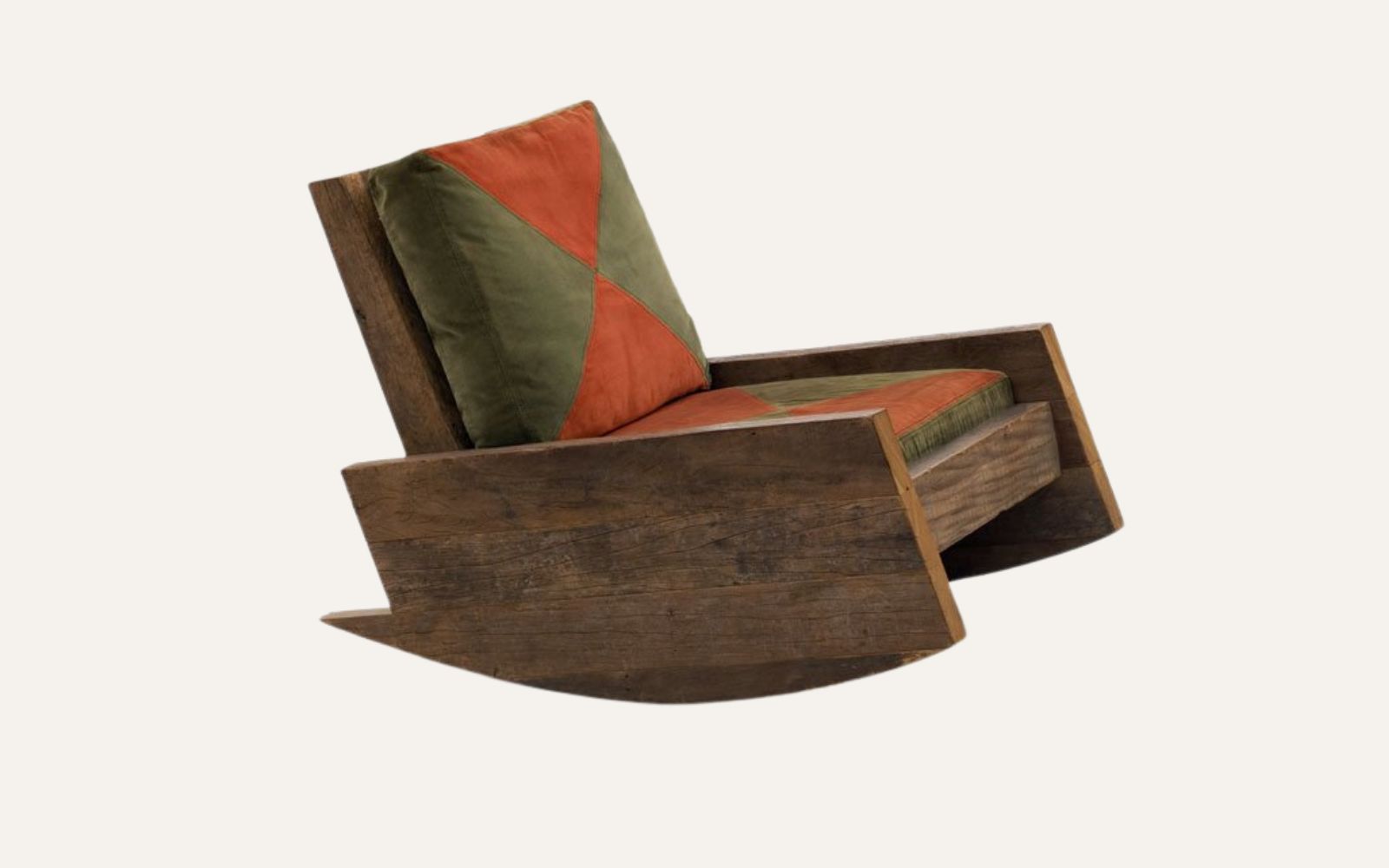 Asturias armchair (1989), Carlos Motta. Credit + license to be confirmed before publishing.
Then there is the hand that made raw mass feel like sanctuary.
Carlos Motta built a language out of solid wood — much of it reclaimed, demolition timber and salvaged beams given a second, more honored life. His pieces are heavy, low, generous, often carved from a single substantial mass. The traço is almost primal: you feel the tree in the furniture. And yet nothing about it is crude. There is enormous refinement in how Motta reads a piece of old wood and decides where to cut, what to keep, which crack becomes a feature and which gets resolved. His work is ecological and tactile — the opposite of glossy, and unmistakably high design.
His Asturias armchair is the piece I would put forward as definitive: broad, grounded, sculpted in solid wood with a presence that fills a room without raising its voice. It is the chair a serious house places where it wants gravity. Motta proved that Brazilian design could be built from what the country already had — sun-aged, water-marked, structurally magnificent wood — and that reclamation, done with this level of eye, reads as richer than anything new.
I specify Motta when a space needs an anchor with conscience: weight that also carries a story about where the material has been.
Jader Almeida — the contemporary proof
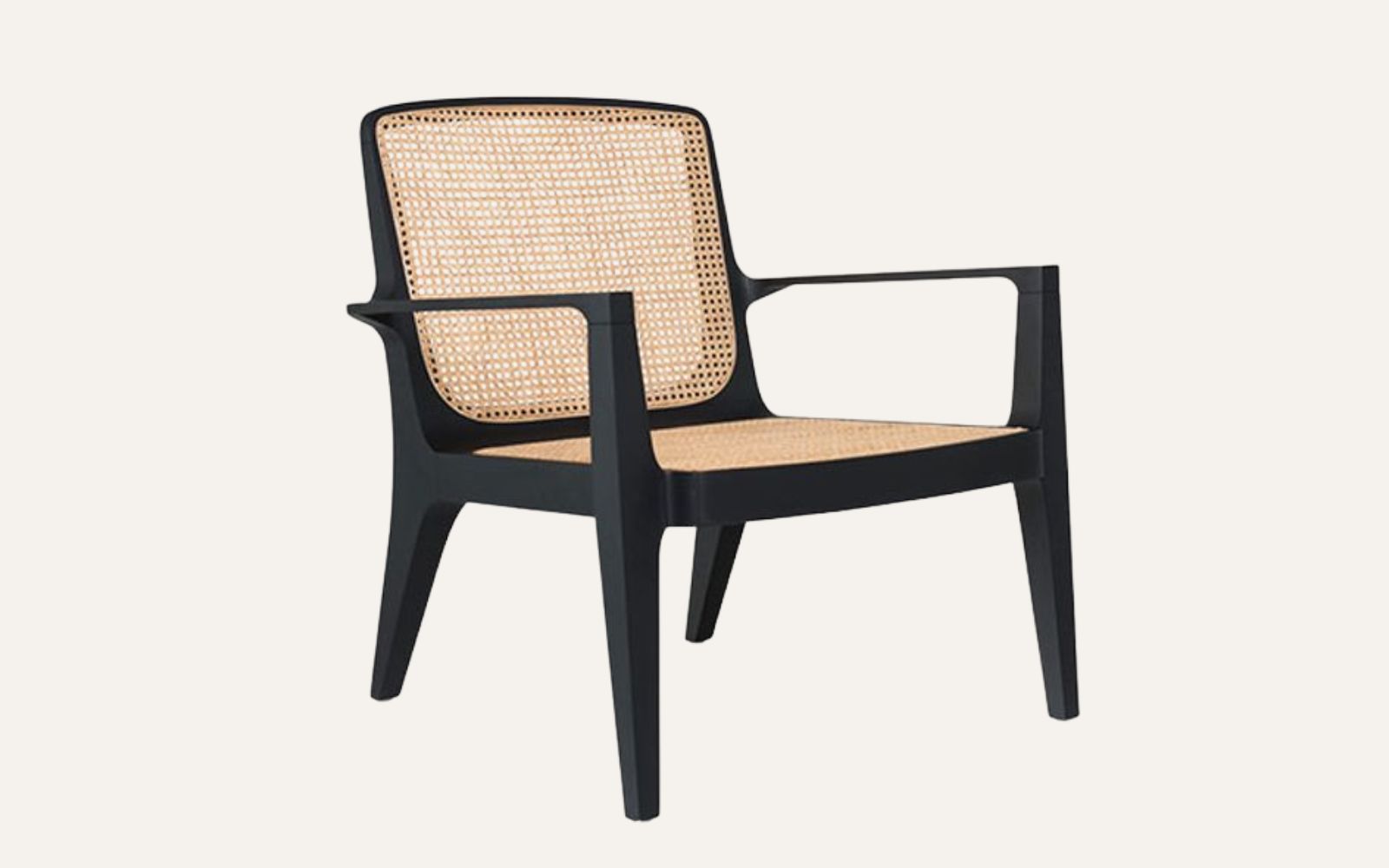 Bossa armchair (2010s), Jader Almeida. Official Sollos / Lin Brasil catalogue is the cleanest licensing route.
The masters are not a graveyard. Jader Almeida is the living proof, and the reason I refuse to let Brazilian design be filed under “heritage.”
Almeida’s traço is the most depurated of the five — clean, taut, resolved to the millimetre. If you saw a Bossa armchair without context you might guess Copenhagen, and that near-miss is exactly the point: he works at the level of precision the world reads as Scandinavian, but the warmth of the wood and the generosity of the curve are Brazilian. He is an industrial designer and an architect, and his pieces are engineered to be produced at scale without surrendering a gram of refinement. This is the hardest thing in furniture — discipline that does not read as cold — and he does it as well as anyone working today, anywhere.
The Bossa armchair is his calling card: a slender solid-wood frame, a curve that looks effortless and is anything but, proportions that feel resolved from every angle. It is the piece that lets me tell an American client, truthfully, that Brazilian design is not a museum visit — it is a living industry producing authored furniture at the global top tier, available now, specifiable now.
Almeida is who I reach for when a contemporary interior needs warmth without weight — the precision of the moment, made in wood that remembers it is from somewhere.
Fernando and Humberto Campana — furniture as sculpture
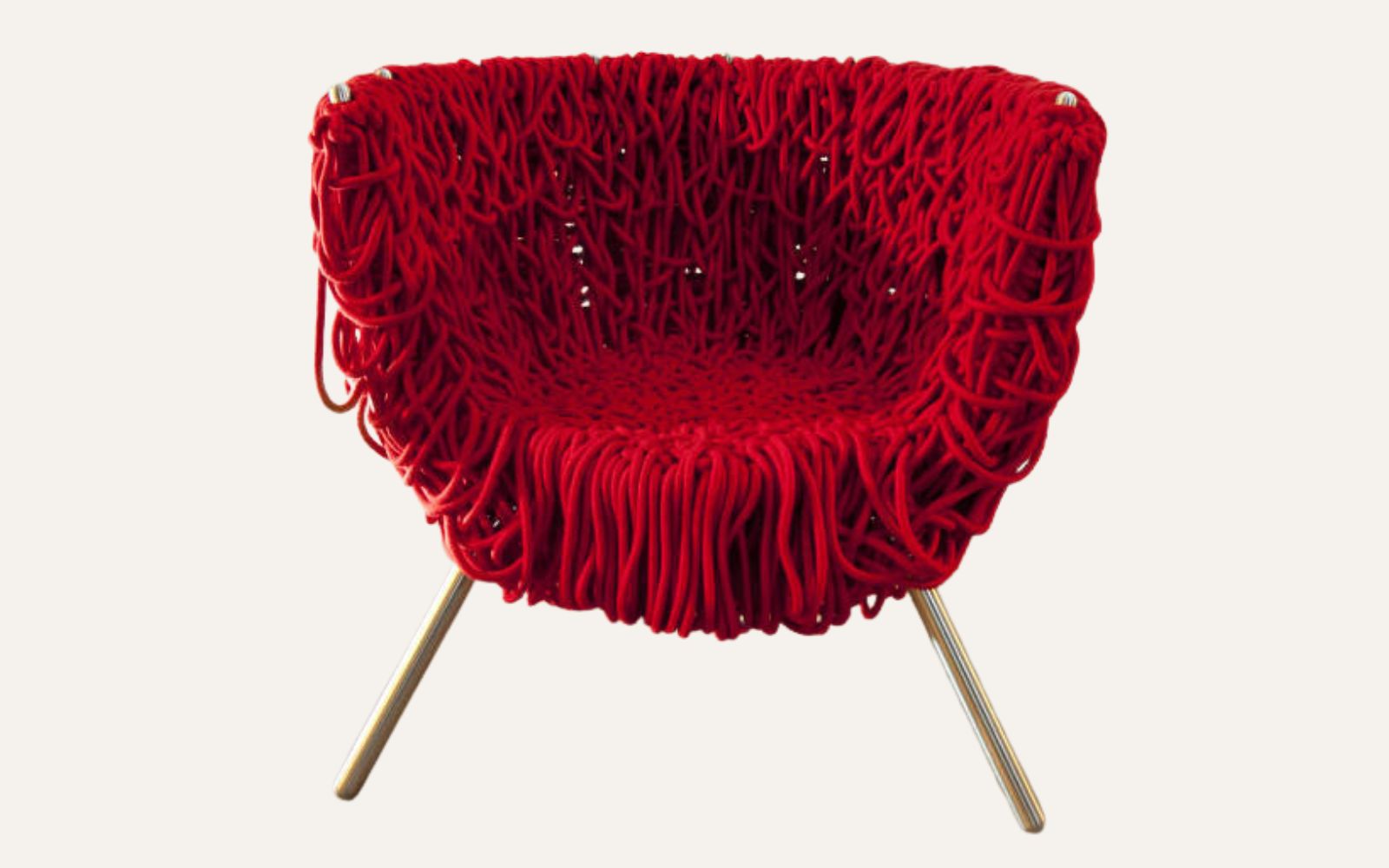 Vermelha chair (1993), Fernando and Humberto Campana. Edra holds pieces in production — credit + license to be confirmed.
And then the hands that refused to stay furniture at all.
The Campana brothers are the artists among these masters — the proof that Brazilian design reaches not just the top of the furniture market but into the museum and the gallery, where the object is collected as sculpture. Their traço is accumulation, profusion, controlled chaos: hundreds of components — rope, scrap wood, stuffed toys, cord — built up by hand into pieces that read as objects of art before they read as places to sit. They take the humblest material in the country and elevate it to the most rarefied tier of collecting.
The Vermelha chair of 1993 is the masterpiece: roughly 500 metres of cotton cord, woven and wound by hand over a steel frame, no two examples truly identical. It is in the permanent collections of the world’s major design museums. It is value in the collector’s sense — scarce, authored, impossible to mass-produce, prized the way a sculpture is prized rather than the way a sofa is. The Favela chair, built from hundreds of hand-nailed wood scraps, makes the same move: poor material, museum object.
The Campanas are who I invoke when a space wants a single piece that functions as art — the chair that anchors a room the way a canvas would, that a collector buys as a work and happens to be able to sit in.
Why these are masters, not a curiosity
Put these five hands together and the argument settles itself. Rodrigues gave Brazilian design its weight. Zalszupin gave it precision. Motta gave it conscience. Almeida gave it a living, contemporary edge. The Campanas gave it the museum. That is not a regional sampler. That is a complete vocabulary of high design — every register a European tradition would claim, present and accounted for, made in Brazilian wood under Brazilian light.
The only reason these names are not the automatic reflex in a New York living room is habit. The work has always been at the altitude. What it has lacked is someone in the room who knows it cold and specifies it with conviction.
That is the work I do. If you are building a project that deserves furniture at this level — and you want a curator who can place a Mole, a Pétalas, a Vermelha for what each one actually is — write to [email protected]. This is the company I know best.