Proof of Purchase
Six pieces of the American canon, and the one test that tells you whether a room chose them or collected them.
Every design icon dies the same death: it stops being a chair and starts being a receipt.
Not all at once. First it earns its status the honest way, by solving something. Then the market notices. Then the room stops asking whether the piece belongs and starts asking whether the guest recognized it. Somewhere in that sequence, a design decision quietly becomes proof of purchase.
The American high-end residential market runs on a short, powerful canon. Herman Miller and Knoll built half of it; Italian and French houses supplied the rest. These pieces circulate through auctions, estates, and design galleries with the confidence of blue-chip stock, and they show up in project after project because they work, and because clients ask for them by name. Nothing wrong with any of that. The problem begins when the icons stop being chosen and start being collected, three or four to a room, each one performing its own fame.
I keep one test for this. Take the name away. Strip the piece of its Wikipedia entry and its auction history, and look at the decision that remains. If the room still explains why that shape is in that spot, the icon is doing design work. If the only remaining explanation is the label, you are not looking at furniture anymore. You are looking at a receipt someone framed.
Run the canon through that test and each piece tells you exactly where it lives and where it dies.
Eames Lounge Chair
The one American icon that survives almost anything, and still gets misused constantly. It was designed as a private object, a chair for one person’s corner, with the warmth of a worn baseball glove. It earns its place when it sits slightly apart from the conversation area, angled toward a window or a bookshelf, clearly belonging to somebody. It dies when it gets promoted to sculpture: centered, lit, and never sat in. A lounge chair no one lounges in is a trophy with an ottoman.
Barcelona Chair
Mies designed royalty seating for a pavilion, and the American market turned it into a pair flanking a fireplace. That symmetry is precisely the mistake. Two Barcelonas facing each other announce a lobby; the piece goes corporate the moment it multiplies. Alone, off axis, given room to be an object rather than a set, it recovers its dignity. This is a chair that should never come in pairs, and almost always does.
Togo
The Instagram resurrection of the decade, and a piece I defend with one condition. The Togo is a slouch, a deliberate collapse, and a collapse only reads against posture. In a room with structure, upright seating, a firm horizon of millwork, the Togo lands as wit. In a room where everything else is also low, soft, and boneless, it disappears into a puddle of its own genre. One slouch per room. The joke stops being funny when everyone tells it.
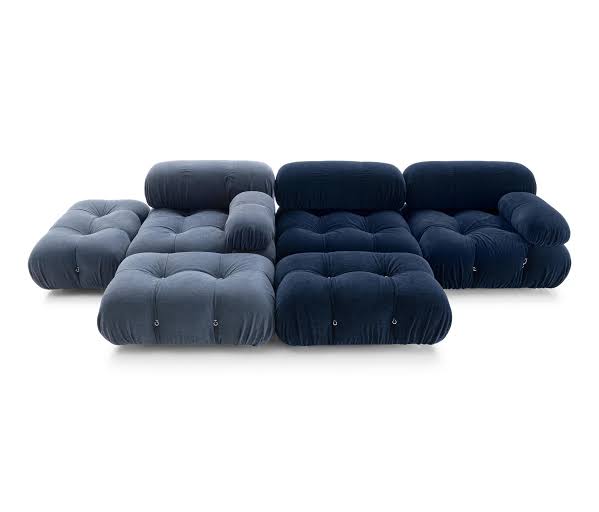
Camaleonda
Bellini’s modular sofa is the piece most at risk right now, because modularity is an invitation the market cannot refuse. The system was designed to be composed; the current fashion is to accumulate. Six, eight, ten modules rolling across an open plan is not composition, it is inventory. The Camaleonda is magnificent at the scale of a gesture and oppressive at the scale of a fleet.
Noguchi Table
The exception that proves the whole argument. The Noguchi passes the no-name test effortlessly because it was never trying to be seen first. Glass disappears, the base reads as sculpture only if you go looking. It is nearly impossible to misuse, and that is exactly why it teaches the lesson: the most durable icon in the canon is the one that recedes.
Arco Lamp
I spend my working days in lighting, so I will say this one plainly. The Arco is not a shape, it is a solution: the Castiglioni brothers built it in 1962 to deliver overhead light to a table in rooms where the ceiling offered no wiring.
The numbers are the argument. The arc reaches 78.6” (2 m) out from a base of white Carrara marble, and the whole object weighs about 141 lb (64 kg). That reach is not styling. It is the distance from a wall to the center of a dining table. The brothers even left a hole through the marble so a wooden pole could carry the thing, because they knew what they had made was too heavy to lift and they designed the moving of it too.
When the lamp does that job, arcing over a dining table or a reading chair, it is one of the most intelligent objects in any room. When it stands against a wall, arching over nothing, switched on for atmosphere, it has been demoted from lamp to logo. Light has a task. An icon of lighting that no longer lights anything specific has failed twice.
The pattern underneath all six is the same one I keep finding in stone, in millwork, in light. Accumulation communicates effort. One icon in a room is a decision; four is a defense. The owner of the single, correctly placed piece is not proving anything, and that is exactly what reads as confidence. The owner of the icon collection is answering a question nobody asked.
There is also a quieter reason to hold the line, and it is generosity toward the piece itself. An icon surrounded by ordinary, well-chosen things gets to be extraordinary. An icon surrounded by other icons gets to be merchandise.
The canon is not closed, either. Sergio Rodrigues’ Mole armchair now moves through the same American auctions as the Eames, which means the argument I made about the Brazilian masters is quietly winning: the market is learning that the list has room. But that is another essay, and I already wrote it.
The test travels well. Take the name away. What remains is either a design decision or a receipt, and every room you walk into has already answered.
If you are working through a room where the pieces are competing for the same job, write to me at [email protected]. It is my favorite kind of problem.