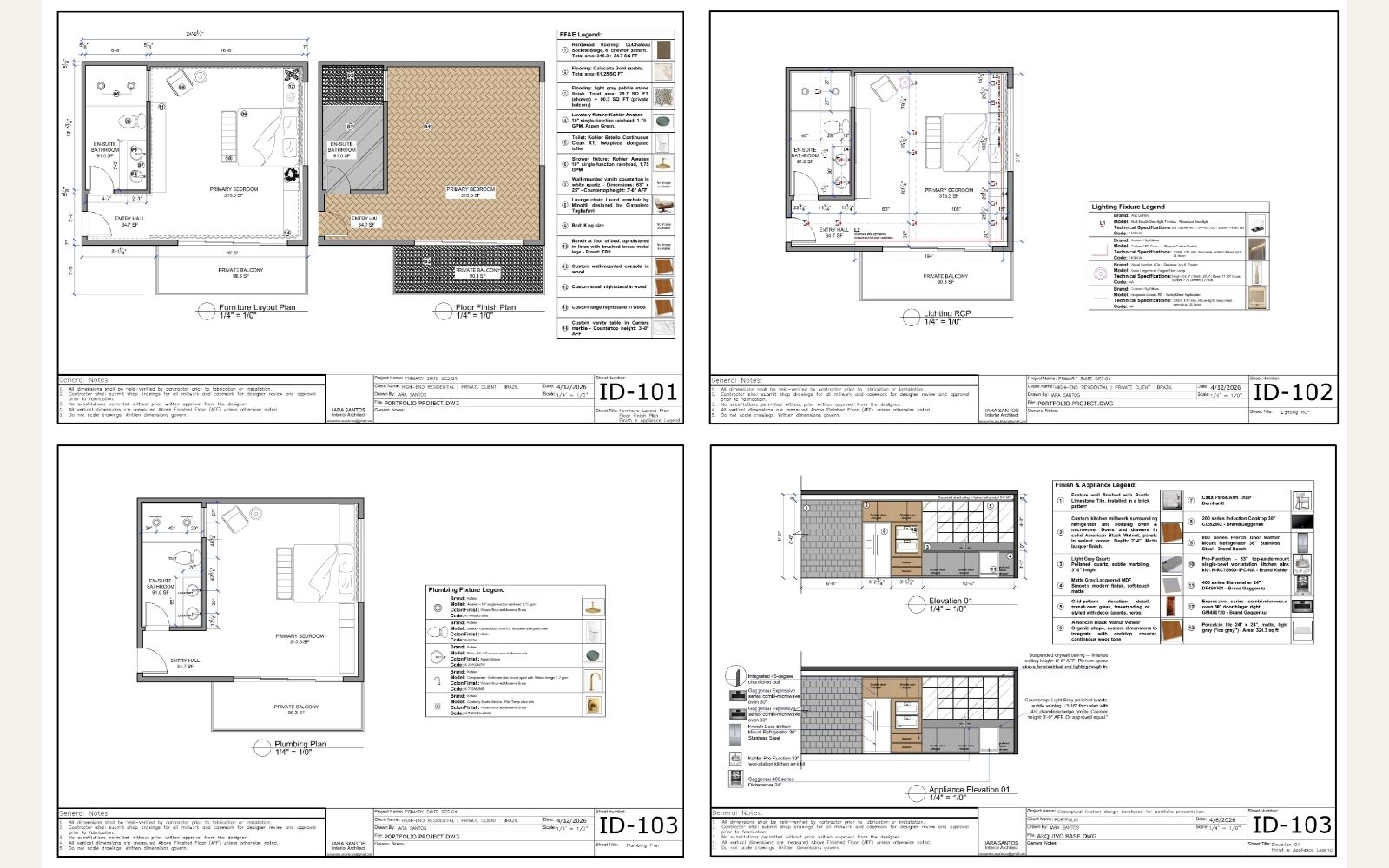
The drawing set is the design
A method note on compatibility — and why the most expensive mistakes in residential construction live in the gap between disciplines.
I once worked on a project where the air conditioning fixtures were installed exactly where the most important lighting fixtures needed to be.
The HVAC plan had been developed independently. The MEP engineer had done his job. The drawings were technically correct on their own. They were also, on arrival to the ceiling, in direct collision with the lighting plan — the recessed downlights I had specified above the dining table, the accent over the artwork, the perimeter wash on the feature wall. All of them had a duct or a diffuser already occupying the slot.
The lighting plan had to be redone. The layout plan had to be redone — because some of the new lighting positions no longer worked with the furniture below. Three weeks of work, repeated. A meaningful portion of the budget, redirected. None of it was negligence. All of it was a single failure: the disciplines did not talk to each other.
This is the part of residential project work that almost no one writes about, and it is the part that decides whether the project gets built the way it was drawn.
What a complete drawing set actually contains
A residential project at the level I produce documentation for is not one drawing. It is a coordinated set, where each sheet talks to the others.
The furniture layout plan with FF&E legend tells the contractor what goes where and what every piece is. The floor finish plan with material codes tells the contractor what surface goes on each square foot. The reflected ceiling plan with fixture schedule and brand-level specs tells the electrical contractor exactly which fixture, at exactly which beam angle, at exactly which height AFF, on exactly which dimmer. The wall elevations show every millwork detail with dimensions sufficient for fabrication. The plumbing plan identifies every faucet, every drain, every shower body by product code. The specification book binds it all together — every product code, every supplier, every applicable code reference, every above-finished-floor mounting height.
Most residential portfolios in Brazil — and a meaningful share of portfolios in the US — do not arrive with this. They arrive with renderings, mood boards, and a partial set of drawings the contractor then has to interpret on site. The contractor’s interpretation becomes the design. That is how rooms get built differently than they were imagined.
What separates a contractable practice from a portfolio
A renderable design is a proposition. A buildable design is a commitment.
The difference shows up not in the photograph after construction, but in the field conditions during construction. When the contractor opens the drawing set and finds the answer to his question on a sheet — not on a phone call, not in a follow-up email, not in a site meeting that pulls the designer away from three other projects — the design holds.
What I have learned, after producing technical documentation for several hundred projects, is that what makes a design hold is not the quality of any individual drawing. It is the compatibility between drawings.
Compatibility is the work most often skipped
Compatibility, in residential design, is the discipline of making sure every plan talks to every other plan, and that every plan respects the constraints of the building system underneath.
The lighting plan respects the structural plan — no recessed fixture is specified where a beam will block the recess. The reflected ceiling plan respects the HVAC plan — no downlight is specified where a duct will arrive. The plumbing plan respects the finish plan — no drain location forces a tile cut that destroys the pattern. The furniture layout respects the lighting — the sofa is not placed under a downlight that will glare into the eyes of someone reading. The millwork respects the FF&E — the cabinet pull does not collide with the appliance handle three inches away.
None of this is glamorous. None of it photographs. All of it is the difference between a project that gets built once and a project that gets built twice.
The reason compatibility is the work most often skipped is that it requires one person — or one coordinated team — to hold all the disciplines at once. The studios that produce coordinated drawing sets are the studios that have someone whose actual job is compatibility. The studios that produce isolated drawings are the studios where each discipline does its job in a silo and trusts the site to figure out the conflicts.
The site does not figure them out. The site builds what arrives. What arrives is the cheaper of the two conflicting decisions. The expensive one — the one that was the actual design intent — gets lost.
The spec book is the closing argument
I produce a full specification book for every project I deliver. This is the document that most often surprises American studios who look at my portfolio.
A specification book is not a list of materials. It is the closing argument of the project. It includes every finish with product code, supplier, available dimensions, lead times where relevant, applicable code references (ADA, IBC, NFPA 101 in the US; NBR equivalents in Brazil), and substitution language that protects the design intent against value-engineering after the fact.
When the contractor receives a spec book, he does not need to call. He builds. When the supplier receives a spec book, the order is not interpreted. It is placed. When the client reviews a spec book, they see the project as a coherent decision, not a collection of preferences.
This is the document that condenses six months of design work into something a construction team can execute without ambiguity. It is also the document that most projects do not have, because it requires a designer who treats documentation as part of the design — not as a step that happens after the design is “done.”
A note for US studios reading this
The drawing standard I work to is the standard your contractors expect. Square footage instead of square meters. AFF callouts on every elevation. IES footcandle guidelines, ADA compliance, IBC referenced where applicable, NKBA guidelines on the kitchen work. The sheets are formatted to US construction conventions. The specification book references US-available products and US codes.
What I think I bring beyond the technical fluency is the compatibility discipline. The drawings talk to each other. The disciplines respect each other. The site receives a document set that does not require interpretation.
If that is the kind of documentation your studio needs — for residential, for lighting, for project management of a coordinated set — write to me.
The argument
Design that lives only as a rendering is a hope. Design that lives in a coordinated, compatible, fully specified drawing set is a plan.
The difference is what gets built.
If you would like to see drawing sets from completed projects, my interior design portfolio carries them. If you have a residential project where the disciplines are not currently talking to each other, write to me at [email protected].